
Alex Ghekas shows how to treat your career like an investment portfolio, building six professional assets (technical skills, communication, experience, ability to learn, initiative, and relationships) that compound over time.
Most actuarial students understand the importance of investing time in exams. Exams are an essential asset in your professional portfolio, and passing them opens doors throughout your career. However, exams are not the only asset that matters.
When actuaries think about portfolios, we usually think about investments. We build portfolios to achieve specific objectives, balance risk and reward, and allocate resources intentionally. Early in my career, I realized that the same concept applies to professional development.
A strong career is built on a portfolio of professional skills that work together over time.
Many students and new professionals focus heavily on one aspect of career growth, usually technical skills and exams. Those are incredibly important, especially early on, but they are only one component of a successful actuarial career.
Just as a well-diversified investment portfolio contains multiple asset classes serving different purposes, a strong career is built on a portfolio of professional skills that work together over time.
Your Career Is an Asset Portfolio
In my current role, part of my responsibility involves helping construct investment strategies. When building a portfolio, we ask questions such as:
- What investment opportunities are available?
- What risks should we take or avoid?
- How should we allocate resources?
- What outcome are we trying to achieve?
Those same questions can be applied to your career:
- What skills are most important for the career you want?
- Where are your strengths today?
- Where are the gaps?
- Most importantly, how are you investing your limited time to improve?
Many students and early-career professionals naturally spend most of their available development time preparing for exams. That is understandable and worthwhile. However, if you want to maximize your long-term impact, it helps to periodically step back and evaluate your entire portfolio of professional skills rather than focusing exclusively on a single area.
Six Professional Assets That Drive Success
When I speak with students preparing for their first jobs, I encourage them to think about six key assets that contribute to professional success.
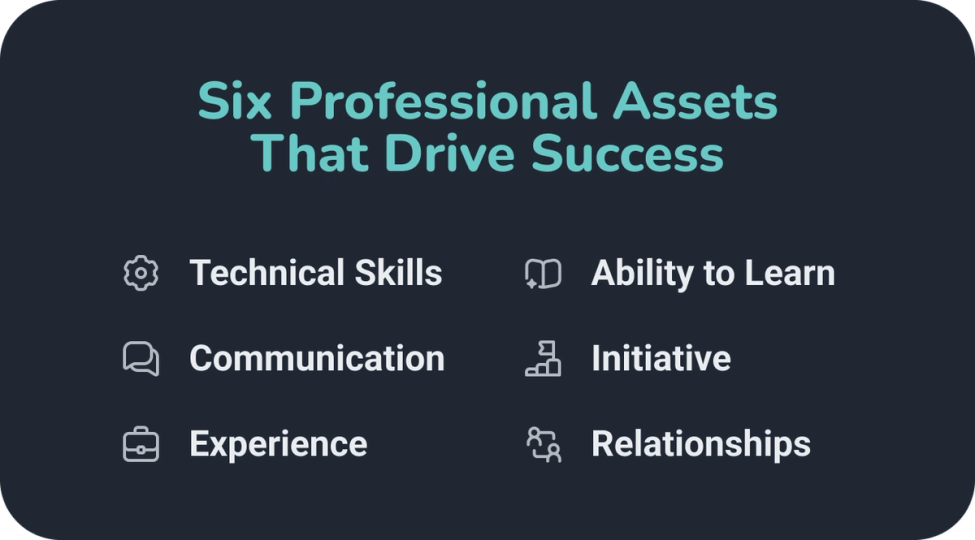
None of these assets exist in isolation. They reinforce one another and compound over time.
Technical Skills
Technical skills are often the most visible component of an actuarial career. Exams, modeling work, programming, analytics, and subject matter expertise all fit into this category. These skills create credibility and allow us to solve increasingly complex business problems.
Technical skills create credibility and allow us to solve increasingly complex business problems.
For students and early-career professionals, technical development deserves significant attention. Strong analytical skills form the foundation of our profession, and there is no shortcut around building them. The discipline required to progress through the actuarial exam process will continue to pay dividends throughout your career.
At some point, however, nearly every actuary discovers that being right and being understood are two different things.
Communication
Communication is the multiplier for technical knowledge. An excellent analysis creates little value if stakeholders do not understand the conclusions or know how to act on them. The most effective actuaries learn how to translate technical concepts into language that resonates with their audience.
Communication is the multiplier for technical knowledge.
This is a skill you can start developing much earlier than many people realize. Presenting during an actuarial club meeting, competing in a case competition, leading a student organization project, or helping another student understand a difficult exam concept are all opportunities to practice communicating complex ideas clearly.
As your career progresses, communication becomes increasingly important because your impact is often determined not only by the quality of your work but also by your ability to influence decisions. I’ve found that hearing how different colleagues communicate the same message can be extremely valuable. Over time, those observations help you develop your own communication style and approach.
Experience
Experience takes time to accumulate, which can make it frustrating for students and professionals early in their careers. The good news is that experience is not solely measured in years worked. It is also shaped by the variety of situations you encounter.
One experience that shaped my perspective occurred during my freshman year at Drake University. I had the opportunity to hear from the former CEO of Principal Financial Group, who was also a Drake alumnus.
What stood out to me was not simply his success, but the path he took to get there. He started as an intern and built a career that eventually led to becoming CEO.
At that stage in my life, I was still trying to understand what opportunities existed within the actuarial profession and the insurance industry more broadly. Seeing somebody who had started in a role that felt attainable to me helped expand my view of what was possible.
Looking back, I gained very little technical knowledge from that interaction. What I gained was perspective.
Seeing somebody who had started in a role that felt attainable to me helped expand my view of what was possible.
Experiences that broaden your understanding of the profession can be just as valuable as those that teach technical skills. Internships, networking events, industry conferences, case studies, volunteer work, and conversations with professionals can all provide experiences that help shape your future career decisions.
Ability to Learn
The actuarial profession changes constantly. Regulations evolve, markets shift, and technology advances. The people who thrive are often those who can learn the fastest.
Curiosity plays a major role here. The best professionals I have worked with continuously ask questions. They seek to understand not only their own work, but also how their work connects to the broader organization.
The best professionals I have worked with continuously ask questions.
Some of the biggest opportunities in my career have come from asking questions outside my immediate responsibilities. Building a broad understanding of how insurance companies operate, how investment strategies support products, and how different teams make decisions provides context that makes all of your technical work more meaningful.
For students, the ability to learn can be demonstrated through exam success and academic success, but curiosity can also be shown by finding avenues to learn about the industry and asking good questions.
Initiative
Career growth is rarely something that simply happens to you. The most meaningful opportunities often begin when someone volunteers, raises their hand, or pursues an area of curiosity before being asked.
One recent example for me involved artificial intelligence. Like many actuaries, I was interested in understanding how these emerging technologies could be used effectively while still maintaining appropriate professional judgment and oversight.
Rather than only reading about the topic, I worked with a team through my role as chair of our Actuarial Education and Development Committee to develop an AI case study for our actuarial community. The case study allowed participants to experiment with AI tools while discussing both the opportunities and risks associated with their use.
What I found most valuable was not the technology itself, but the conversations that followed.
What I found most valuable was not the technology itself, but the conversations that followed. Participants explored where AI could improve productivity, where human expertise remained essential, and how actuarial professionals should think about responsible adoption of these tools.
That experience reinforced an important lesson: initiative often starts with curiosity. Sometimes the best way to learn about something new is to create an opportunity for yourself and others to learn together.
Students can demonstrate initiative in similar ways. Running for a leadership position in an actuarial club, organizing a networking event, learning a new programming language, or pursuing a project outside of coursework all signal a willingness to take ownership of your development.
Relationships
Technical skills may get you into the room, but relationships often determine how much you can accomplish once you’re there.
One of the biggest professional lessons I learned came during a period when I worked fully remotely while much of my team remained together in the office. During that time, I also transitioned to a new team and had to learn a new function while building relationships almost entirely virtually.
The experience reinforced how important relationships are to both professional success and day-to-day job satisfaction. It also taught me that strong professional relationships require intentional effort. They rarely develop by accident.
Strong professional relationships require intentional effort. They rarely develop by accident.
For students, relationship-building may be as simple as introducing yourself to a speaker after an event, attending actuarial club meetings consistently, reaching out to alumni, or scheduling a conversation with a professional working in an area that interests you.
Strong relationships create opportunities for learning, mentoring, collaboration, and professional growth. More importantly, they make the journey significantly more enjoyable.
Periodically Rebalance Your Portfolio
Investment portfolios are not static. Over time, allocations drift and conditions change. Successful investors periodically reassess their portfolios and make adjustments when necessary.
Your professional portfolio deserves the same treatment. Take inventory periodically:
- Which skills are your strengths?
- Which areas need additional investment?
- Are you allocating your time in a way that aligns with your long-term goals?
You may discover that you have invested heavily in technical development but have neglected networking. Or perhaps you have accumulated valuable experience but need to improve your communication skills to maximize its impact.
There is no universal allocation that works for everyone. The right portfolio depends on your goals, interests, and career path. The important part is having a deliberate strategy rather than letting your development happen by chance.
Build Your Portfolio With Intention
When students ask me for career advice, I often return to a simple idea: build a broad network of colleagues, mentors, and advisors who encourage your curiosity and help you learn. Those relationships, combined with a willingness to continuously develop your skills, can accelerate your growth far beyond what exams and day-to-day work alone can provide.
Just as a well-constructed investment portfolio compounds over time, so does a well-constructed professional portfolio.
Your career is a portfolio. Be intentional about how you build it.
About the Author
Alex Ghekas, FSA, MAAA, CERA, is an associate actuary on the General Account Investments team at Principal Financial Group. He graduated from Drake University in May 2019 with a bachelor of science in business administration, majoring in actuarial science and finance, and joined Principal’s Actuarial Development Program that same year. Through rotations in Life Pricing, Principal International, and General Account Investments, he completed the exam process and earned his FSA in 2023, then chose to stay with the General Account team in a permanent role. Today Alex focuses on asset portfolio construction, peer benchmarking, and forecasting asset returns and required capital, and he helps translate General Account activity into implications for pricing strategy and financial results. He also chairs Principal’s Actuarial Education and Development Committee. In fall 2026, the American Academy of Actuaries named Alex a recipient of its 2026 Rising Actuary Award.