
Property & Casualty Predictive Analytics (PCPA) joins the Coaching Actuaries lineup this September, giving ACAS candidates a new way to build the data and modeling skills employers want most.
Predictive analytics has become a bigger part of how P&C organizations solve problems, and that shift is showing up in hiring. Recruiters report that employers increasingly want candidates who bring data and modeling skills alongside traditional pricing and reserving experience.
That's exactly what Property & Casualty Predictive Analytics (PCPA) is designed to develop. Now a required part of the ACAS pathway, PCPA helps candidates build the skills P&C practice increasingly demands.
To help you prepare, we're excited to add PCPA to the Coaching Actuaries course lineup, starting in mid-September!
What Is PCPA?
Unlike any exam you've taken so far, PCPA is structured into two parts: (1) an exam and (2) a project. The exam runs at a Pearson VUE center, where you'll answer 40 questions across 4 item types within a 2-hour testing window. Passing the exam unlocks the project.
The project is where you'll apply those concepts to a realistic business problem. You'll receive a business problem and dataset, conduct exploratory data analysis, and build a generalized linear model in R, Python, or SAS.
Ultimately, you’ll produce a 1,000-word report explaining and supporting your modeling decisions for a nontechnical audience.
Meet Your Team
Your PCPA course is written by Dr. Lendie Follett, Department Chair of Actuarial Science, Analytics, and Information Systems in the Zimpleman College of Business at Drake University.
She earned her PhD in statistics from Iowa State University and has applied Bayesian methods to problems ranging from food insecurity to cryptocurrency volatility.
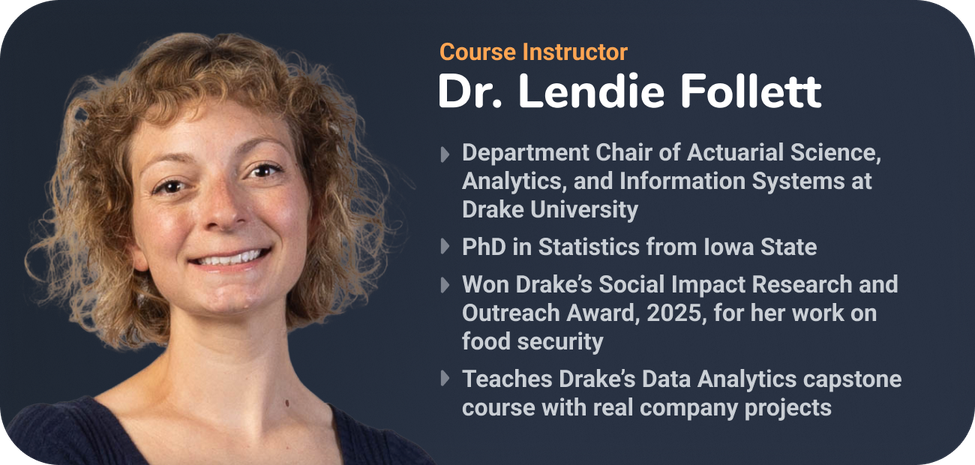
Dr. Follett also teaches Drake's data analytics capstone course, pairing students with companies to solve real-world data problems, and brings that grounding into every lesson. (See a testimonial from a former student, below.)
In 2025, Dr. Follett received the Social Impact Research and Outreach Award from Drake's Zimpleman College of Business. This award recognized her work applying data analysis to expand food security efforts.
Dr. Follett is the best professor at Drake University. She obviously cares about her students [and] creates effective learning environments … I don't think I could ask for a better experience.
Coaching Actuaries president Tong Khon Teh shared his excitement about the collaboration: "Dr. Follett is highly knowledgeable and has a proven track record of teaching effectiveness. Beyond that, she applies her expertise to real-world problems such as food insecurity and the challenges facing non-profits."
Tong continues: “I believe the combination of her subject matter expertise as well as teaching and application experience will be a great benefit to our PCPA students, who will be learning from someone with deep experience in both the theoretical concepts and their applications."
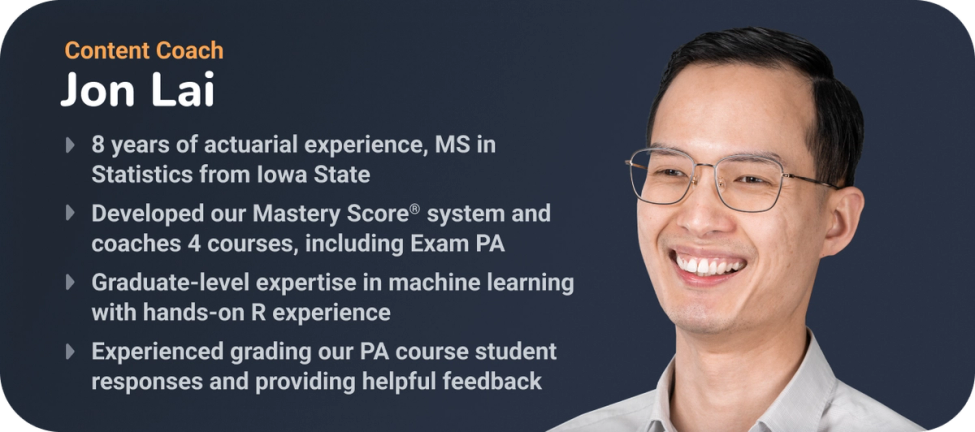
Alongside Dr. Follett, our resident PCPA coach, Jon Lai, is supporting the new PCPA course. Coach Jon holds an MS in statistics from Iowa State University, and he has extensive experience coaching students on predictive analytics through our SOA PA course.
Both Coach Jon and Dr. Follett have graded and coached students on predictive analytics projects and assessments. Both completed the PCPA exam and project themselves to ensure our course product is genuinely useful and tailored to PCPA students’ needs.
Dr. Follett is highly knowledgeable and has a proven track record of teaching effectiveness. She has deep experience in both the theoretical concepts and their applications.
What You'll Learn
The PCPA curriculum covers three domains that build on each other. You'll start with dealing with data (Domain 1), learning to clean and explore a raw dataset and shape it into something you can trust enough to build a model.
From there, you'll move into model diagnostics and selection (Domain 2), where you'll build, test, and compare options, then choose the one that best balances accuracy with something just as important: whether people can actually understand it.
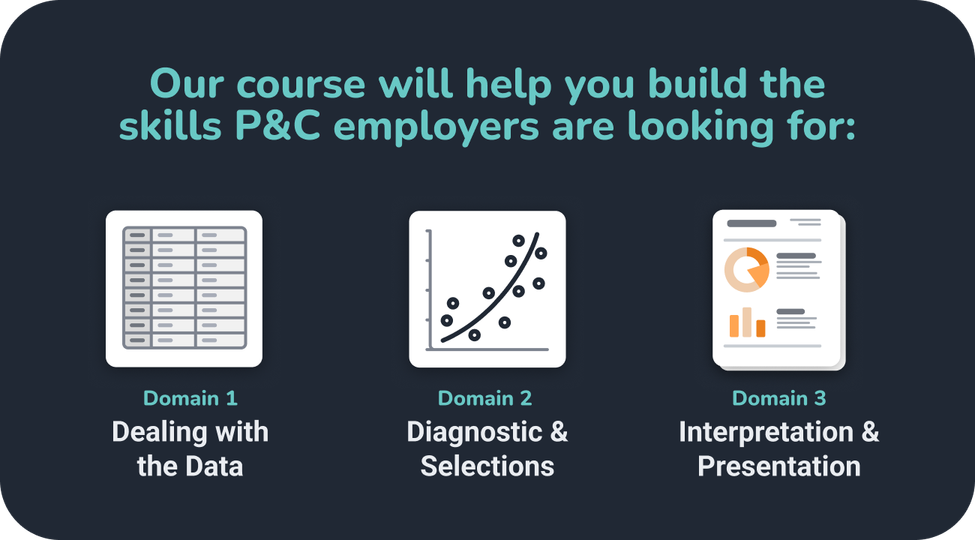
That balance carries into model interpretation and presentation (Domain 3), which teaches you to walk someone without a data background through your decisions and results in a way that earns their confidence, a skill you'll lean on again once you reach the project.
By the end, you'll be able to build sound models and explain them clearly to people who aren't data experts. This skill will serve you well beyond the exam itself.
How We Help You Prepare
Our PCPA course helps you prepare for both the exam and project:
- Clear manuals and focused lessons build your foundation, while our CheckPoints scheduler keeps your prep on track.
- About 300 exam-style practice questions and two Capstone Exams cover the exam component, while 2 mock projects with coach's tips and commentary cover the project component.
- When it's time to review, Summaries help you revisit key ideas quickly and Coach's Remarks walk you through the trickiest concepts.
These tools will help you use your time wisely and keep you focused on what matters most to PCPA success.
Launching Soon!
PCPA is the latest addition to our growing course lineup (see also Exam 6U). The skills you'll build here—cleaning messy data, choosing a defensible model, and explaining it to someone who isn't a data expert—are the same ones recruiters say P&C employers are looking for right now.
Our course is built to help you develop them, not only for the exam and project but also for the work waiting on the other side. Look for PCPA on Coaching Actuaries starting in mid-September 2026. We'll let you know as soon as it's live!